
Why data analytics has become strategic
Data analytics refers to the analysis of raw data in order to draw out an actionable context and meaning. Without this process, data remains inert: it provides no useful information to decision-makers and cannot support any informed choice, no matter how much of it piles up in the data warehouse.
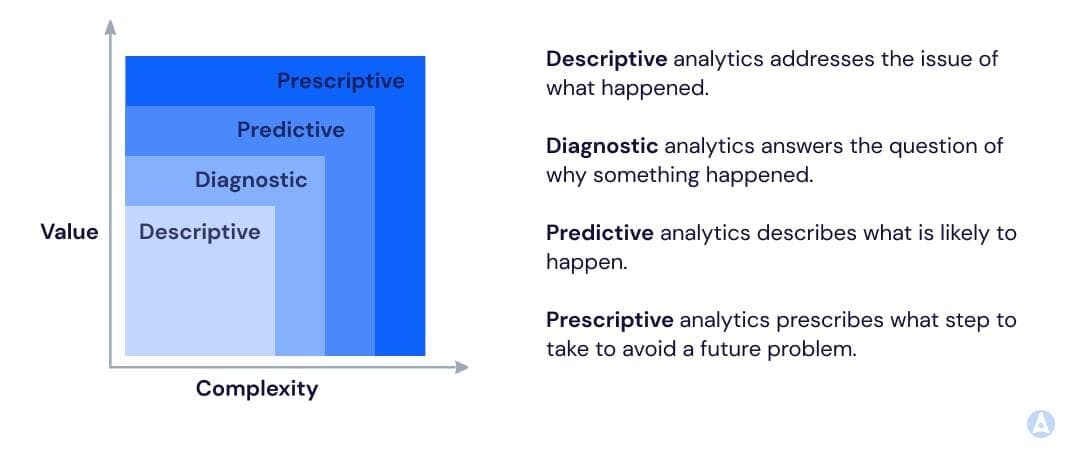
Turning data into a decision-making lever means choosing the right analytical approach. There are traditionally four main types of data analytics, complementary and increasingly complex, along with a series of tangible benefits for the organisation. By 2026, the spread of cloud data platforms and analytical copilots has made these four approaches accessible to far broader teams than before, well beyond data scientists alone.
This democratisation also changes the nature of the work: business analysts spend less time preparing data and more time interpreting results and challenging the recommendations produced by tools. Understanding the four types of analysis and how they connect thus becomes a cross-functional skill, useful well beyond data teams.
Descriptive analytics: understanding the past
Descriptive analytics examines historical data to highlight trends and relationships. Its goal: to help the business understand its past performance before trying to explain or anticipate it.
Key performance indicators
It relies on key performance indicators such as return on investment, revenue per customer or year-on-year sales growth. These KPIs form the backbone of any management dashboard and serve as a reference to measure the impact of decisions taken afterwards.
Modern reporting tools and practices
Modern business intelligence platforms now automate a large share of this work: continuous dashboard refreshes, threshold alerts and, increasingly, natural-language summaries generated on demand. This automation frees up time for interpretation, which remains a human task, and shifts the analyst's added value toward asking the right questions rather than manually building charts.
Diagnostic analytics: understanding the why
Diagnostic analytics focuses on the present situation. It builds on the findings of descriptive analytics to answer "why" questions: why did sales decline this quarter, why did churn increase on a given segment?
Statistical techniques for root-cause analysis
It identifies root causes using statistical techniques such as correlation analysis, segmentation or hypothesis testing, and often cross-references several data sources to rule out false leads. This step is what turns a superficial correlation into a genuinely actionable cause.
From analysis to shared decision-making
Once causes are identified, the challenge is to share these insights with stakeholders in an understandable format, far from statistical jargon. Clear data governance, with shared metric definitions and identified owners for each dataset, directly conditions the quality and credibility of these diagnostics, without it, two teams can reach contradictory conclusions from the very same events.

Predictive analytics: anticipating outcomes
Predictive analytics combines historical data with machine learning methods to anticipate future outcomes. It allows the business to avoid certain risks and to spot opportunities before they arise.
Machine learning and forecasting models
Common methods range from decision trees and random forests to neural networks, alongside time-series models for demand forecasting. By 2026, these models are increasingly deployed via MLOps platforms that automate their training, validation and continuous updating as data evolves.
Concrete use cases
Stock-out forecasting, credit risk scoring, predictive maintenance on industrial equipment or anticipating customer churn: these use cases share a common thread, the need for a historical record rich and clean enough for the model to learn reliable patterns. A predictive model trained on incomplete or biased data will produce confident but wrong forecasts, which makes data quality work as critical as choosing the algorithm.

Prescriptive analytics: recommending the best action
Prescriptive analytics goes even further. Drawing on machine learning, it determines the best course of action for a specific scenario. It thus answers a decisive question for leaders: "what should our business do next?"
The contribution of generative AI and agents
Recent advances in generative AI now let analytical agents phrase recommendations in natural language, explain the underlying reasoning and simulate several optimisation scenarios before a human decision-maker settles on one. This conversational layer makes prescriptive data accessible to non-technical business teams.
The limits to keep in mind
This power has a flip side: a recommendation generated by a model still depends on the quality and freshness of its training data, and can replicate historical biases if it isn't audited. Prescriptive analytics should remain a decision-support tool, not a substitute for human judgement on the most sensitive issues, particularly when recommendations touch decisions with high human or regulatory impact, such as credit or hiring.
The concrete benefits for the business
The benefits of data analytics are numerous and can be measured directly against business outcomes, not just the quality of reports produced. An organisation that correctly connects its four types of analysis also gains decision agility: it detects weak signals earlier and reacts before the fastest competitor gets ahead.
Productivity and operational efficiency
By revealing recurring patterns, it streamlines processes and improves operational efficiency. Diagnostic analytics highlights training and hiring needs, which directly supports team productivity. It also sheds light on customer trends through tools such as Looker or Tableau, which track metrics like customer lifetime value or cost of acquisition.
Cost reduction and risk control
It helps cut costs by identifying the most profitable products and future savings, and mitigates risk by providing fraud analysis and near real-time threat forecasts. Organisations that structure their analytics chain end to end regularly report double-digit gains on operating costs within a few quarters, along with a marked reduction in time spent manually producing reports.

The Adservio approach: a coherent value chain
At Adservio, we see data analytics as a coherent value chain rather than a collection of isolated tools. Descriptive, diagnostic, predictive and prescriptive: each type of analysis answers a specific business question, and it is by combining them, on a foundation of governed and trustworthy data, that data is truly turned into decisions.
Our conviction: value comes from use, not from accumulating data. We support your teams in structuring their analyses, choosing the right methods according to their objectives, relying on the right MLOps and governance tooling, and gaining the autonomy needed to draw lasting value from them, from the first descriptive dashboard to AI-driven prescriptive recommendations.
STAY POSTED
Get our next analyses and field notes straight to your inbox.