Why product reliability has become a strategic priority
Product reliability refers to the probability that a product, system or service adequately performs its intended function over a defined period. For any company offering digital products, achieving a high level of reliability is essential because it directly affects user satisfaction and trust. An abandoned cart after a timeout, a mobile app that slows down during a traffic spike, or a partner API that responds inconsistently, all carry a direct cost on revenue and on brand reputation.
The principles of site reliability engineering, SRE, offer a framework to get there. They mark a shift from traditional service management practices towards a more proactive approach, focused on reliability and suited to the demands of modern digital products: distributed architectures, continuous deployment, multiple cloud dependencies and near-real-time user expectations.
The limits of traditional ITSM for modern digital products
For a long time, organisations measured reliability through indicators such as server availability or network latency. The problem is that these metrics reflect neither customer satisfaction nor the real user experience. A server can show 99.9% availability while a checkout journey stays degraded for part of the user base, or a key feature fails silently without triggering any infrastructure alert.
Relying solely on traditional ITSM and monitoring practices is no longer viable for complex digital services, made up of dozens of microservices, event queues and third-party dependencies. The proposed path is to combine ITSM with SRE practices, for a more complete approach that incorporates service-level objectives, SLOs, and indicators centred on the user journey rather than on infrastructure health alone.
SRE: a discipline born at the hyperscalers, now mainstream
Site reliability engineering was born at Google in the early 2000s, before spreading widely across the digital industry. The founding idea fits in one sentence: treat operations as a software problem, entrusting reliability to engineers who write automation code rather than execute repetitive manual procedures. This philosophy has since spread well beyond the cloud giants, reaching mid-sized e-commerce platforms and public-sector IT departments alike.

By 2026, SRE is no longer confined to large web platforms: it now shapes the reliability of payment platforms, digital health systems and connected supply chains, wherever downtime carries a direct, measurable business cost.
The seven core SRE principles
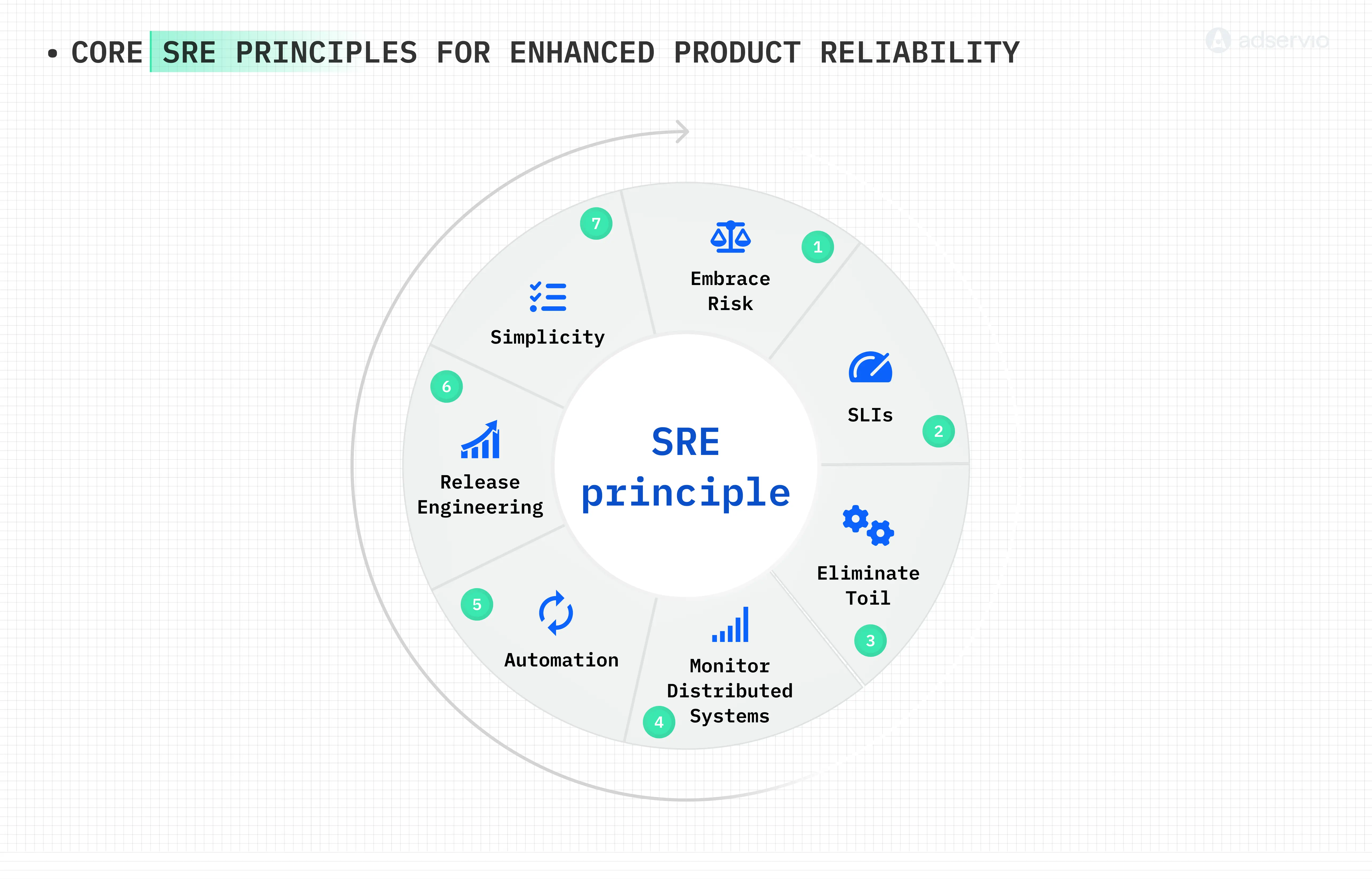
SRE rests on seven mutually reinforcing principles. They do not work in isolation: it is their combination, sustained over time, that turns reliability from a wish into a measurable discipline.
Embrace risk and measure with SLIs
The first principle is to embrace risk: rather than aiming for absolute reliability, which is both illusory and costly, you balance risk using an error budget that measures the acceptable level of downtime over a given window, often a rolling thirty or ninety days. The second principle draws on service-level indicators, SLIs, measurable metrics such as request success rate or 95th-percentile latency, which feed SLOs and objectively assess the reliability users actually perceive.
Eliminate toil to reinvest engineering time
The third principle aims to eliminate toil, the repetitive, manual tasks with no lasting value, such as access management, account creation or manually restarting services, by automating or removing them. A common target for mature SRE teams is to cap toil below 50% of engineering time, with the remainder spent on engineering projects that durably reduce operational load.
Monitor, automate and industrialise releases
The following principles complete the picture. Monitoring distributed systems lets you detect the incidents that compromise reliability, such as network outages, resource saturation or performance regressions after a deployment. Automating repetitive processes improves efficiency and reduces operational costs. Release engineering industrialises service launches, through progressive rollout patterns such as canary or blue-green deployments, to deliver consistent, reversible updates.
Pursue simplicity
Finally, the pursuit of simplicity reduces accidental complexity, the main source of operational errors and cascading incidents, in favour of a more legible architecture and a more robust operating experience. Every component added without clear justification is one more point of failure to monitor, document and evolve.
Building the organisation: a tiger team dedicated to reliability
No SRE principle has a lasting effect without an organisation to carry it. Implementation typically starts with assembling a tiger team, a tight, cross-functional group with expertise in incident management and reliability. It usually brings together infrastructure profiles, automation engineers, monitoring specialists and developers who know the product from the inside.

Their mandate is clear: track SLOs day to day, arbitrate risky changes and prevent production incidents by continuously measuring mean time to detect and resolve. This team acts as a bridge between developers, focused on shipping features, and operations, focused on stability, without ever becoming yet another silo that slows deliveries down.
A four-step implementation
Once the team is in place, implementation follows a four-step path, sequenced yet iterative, that avoids the classic pitfall of trying to measure and automate everything in the first month.
Step 1: assemble the tiger team and scope the pilot
The first step formalises the tiger team described above and picks a pilot scope: a single critical product or journey, rather than the entire application portfolio. This deliberately narrow choice makes it possible to learn fast and demonstrate measurable value before extending the effort.
Step 2: define clear SLOs and SLIs
The second step is to define clear SLOs and SLIs, identifying the components and metrics to track in order to assess availability, latency and error rate from the end user's point of view, not just the underlying infrastructure's.
Step 3: strengthen operational reliability
The third step concretely improves reliability through a multidimensional approach: strengthen incident management, run thorough, blameless post-incident reviews, automate low-complexity routine incidents, document responses in runbooks, and review the architecture of the most fragile components, with particular emphasis on effective change and release management.
Step 4: assess impact and extend the approach
The fourth step, after around six months or six SLO cycles, reviews the real impact on reliability, analyses the tiger team's effectiveness against indicators such as MTTR or change frequency, and then extends the approach to other products in the portfolio, one product at a time rather than all at once.
Measuring, iterating and industrialising the SRE approach
SRE is not a one-off project but a discipline of continuous improvement. SLOs must be reviewed at regular intervals, typically every quarter, to stay aligned with real user expectations and product changes. An error budget burned too fast signals that delivery should slow down in favour of stability; an error budget never consumed instead points to an overly conservative SLO, needlessly holding back innovation.
This regular instrumentation turns post-incident reviews into raw material for continuous improvement, and makes it possible to justify, with hard numbers, reliability investments in front of product and business leadership, often more receptive to ROI than to purely technical arguments. A shared reliability dashboard, showing SLOs, consumed error budget and trends over recent quarters, then becomes a common language between engineering teams and decision-makers.
Towards AI-augmented SRE in 2026
2026 marks a turning point for the discipline: observability platforms now embed AI agents capable of automatically correlating thousands of signals, proposing a root-cause diagnosis within seconds, and triggering pre-approved remediations for low-complexity incidents. Standardised protocols make it easier to exchange context between these agents and monitoring, ticketing and deployment tools.

This automation does not replace the seven SRE principles: it accelerates their execution, reducing residual toil and freeing engineers for the decisions that genuinely require business judgement. At Adservio, we support teams in adopting these principles, augmented with AI where it delivers measurable value, to build durably reliable products.
STAY POSTED
Get our next analyses and field notes straight to your inbox.