Energy & Utilities
Intermittency to manage minute by minute, NIS 2 landing on SCADA systems, remote assets to maintain. We industrialise grid forecasting, OT cybersecurity and predictive maintenance with energy companies and grid operators.
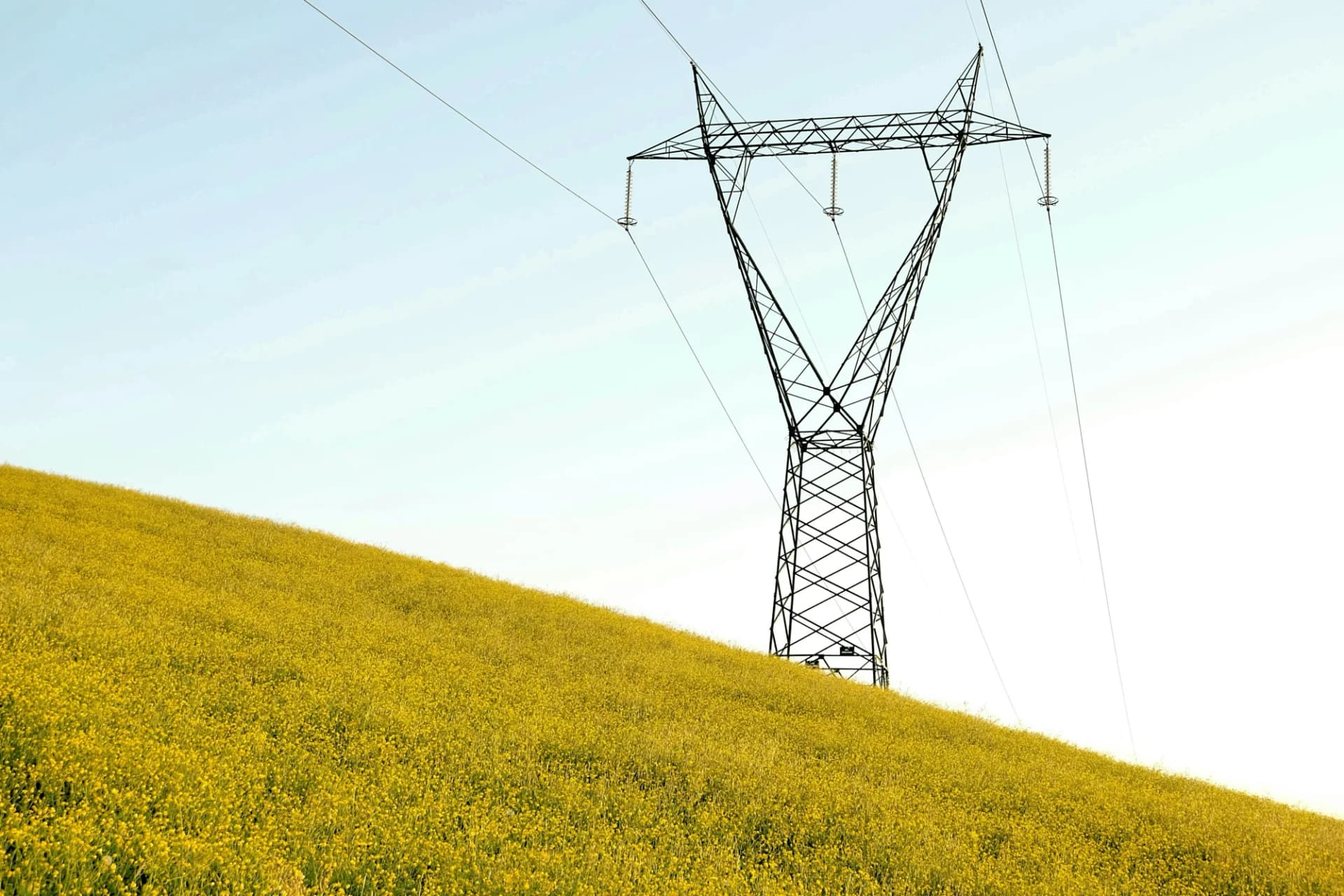
Balance, secure and decarbonise at scale.
Three subjects come up in every conversation with an energy company or a grid operator. They govern everything else: what gets forecast, what gets protected, and what gets maintained before it fails.

Forecasting the supply and demand balance
Models predicting from five minutes to twenty-four hours, combining weather, renewable generation and meter telemetry. Your operators move from reacting to anticipating.
Protecting OT without stopping production
Behavioural detection on the industrial network, continuous monitoring and a continuity plan that has been rehearsed. The sector is classified as essential under NIS 2: compliance is demonstrated, not declared.
Maintaining before the failure
Computer vision on drone inspections and models on sensor time series, with the work generated inside your maintenance system. A remote estate is watched from the data first.
Three stakeholders, three expectations
An energy platform is not bought in the same place as a compliance plan. Here is what each of them expects from us, and what they get first.

Grid operations
Balancing intermittent generation against demand that moves by the minute, on a network whose state is read through millions of measurement points.
Multi-horizon forecasting connected to your field data, with the gap against actuals measured every week.

Industrial and asset operations
Holding the availability of distributed assets, often remote, where every intervention costs a journey and sometimes a production stop.
Maintenance triggered by sensor data rather than by the calendar, with the work orders written into your maintenance system.

IT and OT cybersecurity
A sector classified as essential under NIS 2, exposed control systems, and compliance that has to be demonstrated rather than asserted.
Behavioural detection on the industrial network and an audit trail produced continuously, ready for inspection.
Client cases
A few projects we've delivered with electricity and gas distribution operators and international energy groups.
 Energy
Augmented CIO: a sovereign AI foundation across the SDLC
A gas distribution operator in France
We augmented the Spec, Dev, Test and Ops phases on a self-hosted LLM platform, with an agent marketplace built up pillar by pillar.
 Energy
Connection IS modernisation via SAP Fiori
A gas distribution operator in France
We redesigned the gas connection process interface and harmonised the screens for the national teams.
 Energy
Grid steering through data visualisation
An electricity distribution operator in France
An agile tool to schedule and prepare field operations, across the grid and the customer base alike.
 Energy
EBIOS RM risk analysis on Azure
An international energy group
We industrialised a reusable EBIOS RM method for cloud compliance on a global scale.
Solutions
Smart grid forecasting
(01)Intermittent RES to integrate, unpredictable demand peaks and supply-demand balancing that plays out minute by minute.
Multi-horizon ML models (5 min to 24 h), weather integration, Linky smart-meter IoT aggregation and automated balancing via agentic DERMS.
Energy trading & EPEX
(02)Volatile spot prices, ECB and CRE constraints, and the need to explain every energy trading strategy.
Explainable AI trading agents, multi-asset portfolio optimisation, MIFID II + REMIT compliance and backtesting on EPEX history.
SCADA cyber & NIS2
(03)A sector classed as essential under NIS2, exposed SCADA / DMS / EMS, rising state-sponsored attacks and still-weak segmentation.
Behavioural detection on the OT grid (IEC 62443), 24/7 energy SOC monitoring, IEC 61850 compliance and a tested continuity plan.
Wind & PV asset maintenance
(04)Remote wind farms, PV panels that degrade over time, high offshore maintenance costs and difficult access.
Drone computer vision paired with sensor time-series ML, predictive maintenance on critical components and automated CMMS tickets.
Energy transition & RES
(05)Complex integration of wind, PV and H₂, flexibility to manage, a growing prosumer base and multi-vector optimisation.
A multi-energy orchestration platform, AI-piloted Virtual Power Plants, prosumer aggregation and CO₂/cost/security optimisation.
Smart metering & Linky
(06)Massive meter data volumes, grid operator latency and B2C/B2B value that remains under-exploited.
A Kafka streaming pipeline paired with a time-series DB, anomalies detected in real time, personalised B2C recommendations and CRE compliance.
Compliance & standards
NIS2
Energy essential sector
IEC 62443
Industrial OT cybersecurity
IEC 61850
Smart grid communications
AI Act
High-risk trading & grid models
REMIT
Energy market integrity
CSRD
Sustainability reporting
CRE
Grid codes & compliance
SecNumCloud
ANSSI-qualified hosting
Stack & partners
Mistral AI
European sovereign LLM
Anthropic Claude
Modèles frontière via gateway
Time-series DB
InfluxDB · TimescaleDB · QuestDB
Edge AI
Industrial IoT · Jetson · Raspberry CM
EMS / DMS / DERMS
Schneider · Siemens · GE Vernova
Energy APIs
RTE · grid operators · EPEX
Our ideas
AI and IT resilience
How AI shifts IT resilience from reactive to anticipatory: pattern recognition, automation, threat detection, observability, and the limits of full automation.
Read the article

Let's talk about your energy roadmap
Let's take the time to assess your smart grid, OT cyber and transition challenges, and pinpoint your first AI opportunities together.
Frequently asked questions
A useful clarification first: NIS 2 applies to you, the regulated entity, not to us. A supplier cannot make compliance "native"; it can make it demonstrable. In practice we design the zone and conduit segmentation to IEC 62443, produce the incident register and risk analysis the regulator expects, and rehearse the continuity plan rather than document it. ANSSI counts around fifteen thousand entities in scope in France across eighteen sectors, against five hundred under NIS 1: the implementing decrees and the official list land during 2026, with the first inspections to follow.
Through the trail, not the promise. Every decision keeps its input variables, the contribution of each to the score, the business rationale and who validated what. REMIT requires five years of transaction record retention, which sets our default horizon, and the logs are exportable for the French energy regulator as well as for ACER. On the European AI regulation, the timing changed: regulation 2026/1744 of 24 July 2026 moved high-risk obligations to 2 December 2027 for standalone systems, and to 2 August 2028 for AI embedded in a regulated product. That extra time is for building the documentation, not for waiting.
On our energy engagements, we see ×4 short-term forecast accuracy, −12% balancing cost and +30% RES integration with no additional grid investment. Payback typically lands between 9 and 18 months, depending on portfolio size and sensor maturity.
Read-only first, replacing nothing. We connect through the protocols your systems already expose, IEC 61850 and OPC UA, and through the interfaces of the main control-system vendors. The analysis layer runs inside your perimeter or in sovereign cloud depending on how sensitive the data is. What takes time is not the protocol: it is reconciling your asset registers across the EMS, the DMS and the maintenance system, which rarely name the same equipment the same way.
Framing takes 2 to 6 weeks depending on scope, sector and the level of compliance required. A first orchestrated sub-portfolio in a real environment follows in 4 to 10 weeks, depending on system complexity and the number of integrations. Extending to the full portfolio, including training the control room teams, runs to 3 to 6 months. These ranges are the ones we apply everywhere, and each comes with what makes it vary: a duration announced without its variable only exists to be exceeded.
The first question to settle is whether you are still in scope. The Omnibus directive of 18 March 2026 raised the thresholds to one thousand employees and four hundred and fifty million euros of revenue, taking a large share of the initially covered companies out of the mandatory scope, and the later waves were postponed to 2028. For those still in scope, we automate the collection and the calculation, from sensor data through to the footprint per MWh generated. We do not automate the report itself: it goes through external assurance, and a chain claiming to replace that would expose you rather than protect you.